There are dates that Mongolians simply do not let pass. March 18th — Mongolian Armed Forces Day — is one of them. Every year, the country pauses to honour its military, not as a matter of protocol, but as a living extension of a thousand-year warrior tradition.
From Genghis Khan to today's soldiers, from the open steppe to the modern barracks of Ulaanbaatar, this celebration says something essential about Mongolian identity: strength, discipline, and the quiet pride of belonging to a nation that once shook the world.
For the curious traveller, it is a rare chance to witness Mongolia from an unexpected angle — solemn, vibrant, and deeply human.
When is Mongolian Army Day?
Mongolia's Armed Forces Day is celebrated every year on March 18th. The date commemorates the founding of the modern national army in 1921, established in the wake of the revolution that gave birth to the Mongolian People's Republic.
It is an official public holiday. Government offices close, military ceremonies take place in barracks and public squares, and a strong sense of national pride fills the streets of Ulaanbaatar and provincial cities alike.
If you are travelling in Mongolia at this time of year — March is still cold but luminously bright — you will have the opportunity to witness a side of the country that few visitors ever see.
An army heir to Genghis Khan
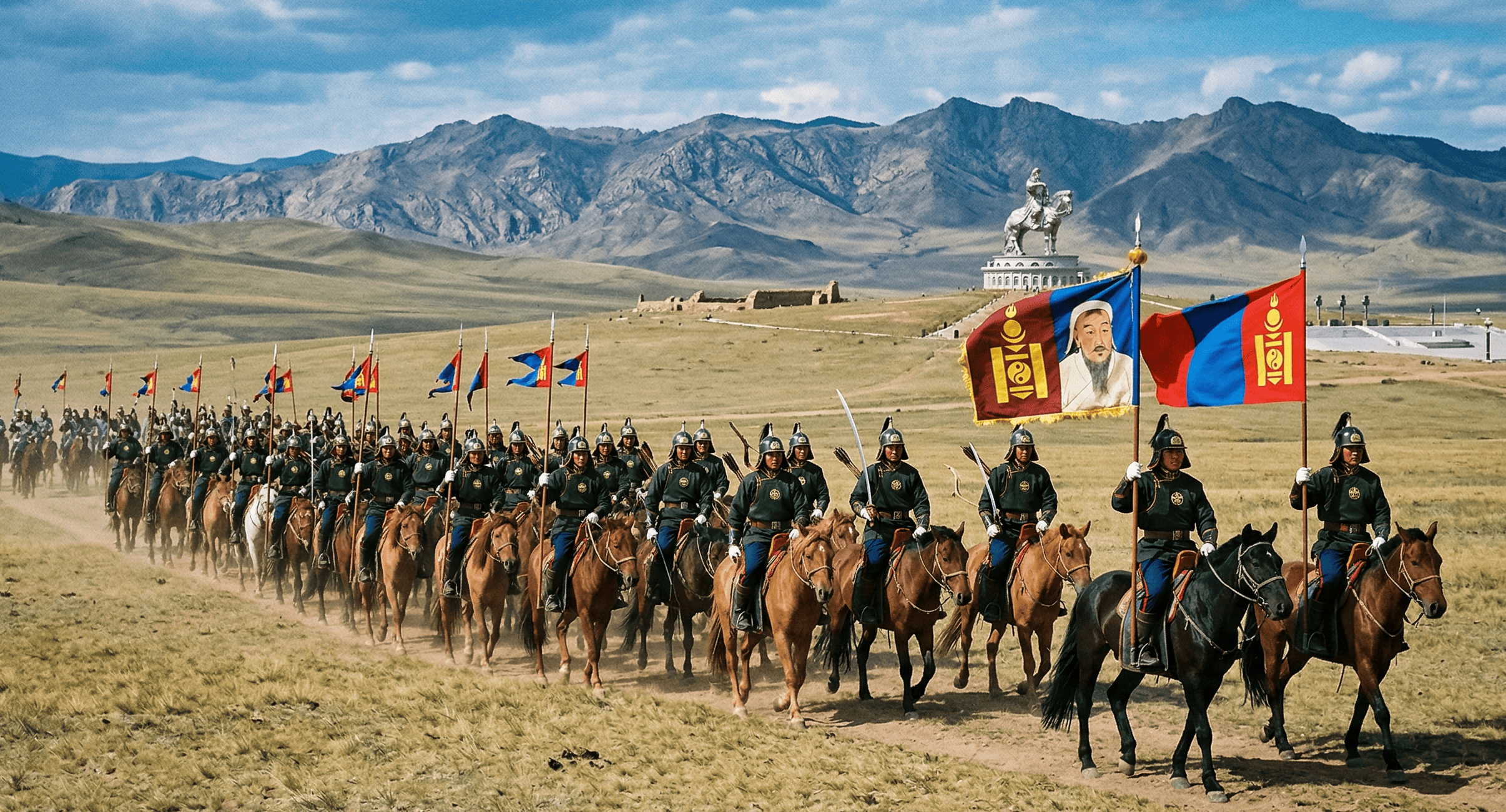
To understand why this day resonates so deeply in Mongolia, you need to travel back to the 13th century. Genghis Khan — Чингис хаан — was not simply a conqueror. He was the architect of the most formidable war machine in human history: an army of nomadic cavalry, perfectly organised, capable of covering thousands of kilometres and coordinating offensives across multiple fronts simultaneously.
The military innovations of the Mongols in the 13th century — the decimal organisation of units (groups of 10, 100, 1,000 and 10,000 men), long-distance communication by visual signals, logistics in hostile terrain — are still studied in military academies around the world today.
Mongolia's modern army claims this heritage directly. The symbols, the ceremonial uniforms, the rituals: everything is a reminder that behind the contemporary soldier stands the shadow of the mounted warrior.
"Genghis Khan was not simply a conqueror. He was the architect of the most formidable war machine in human history — and Mongolia's army today still claims that legacy as its own."
Ceremonies and parades on March 18th
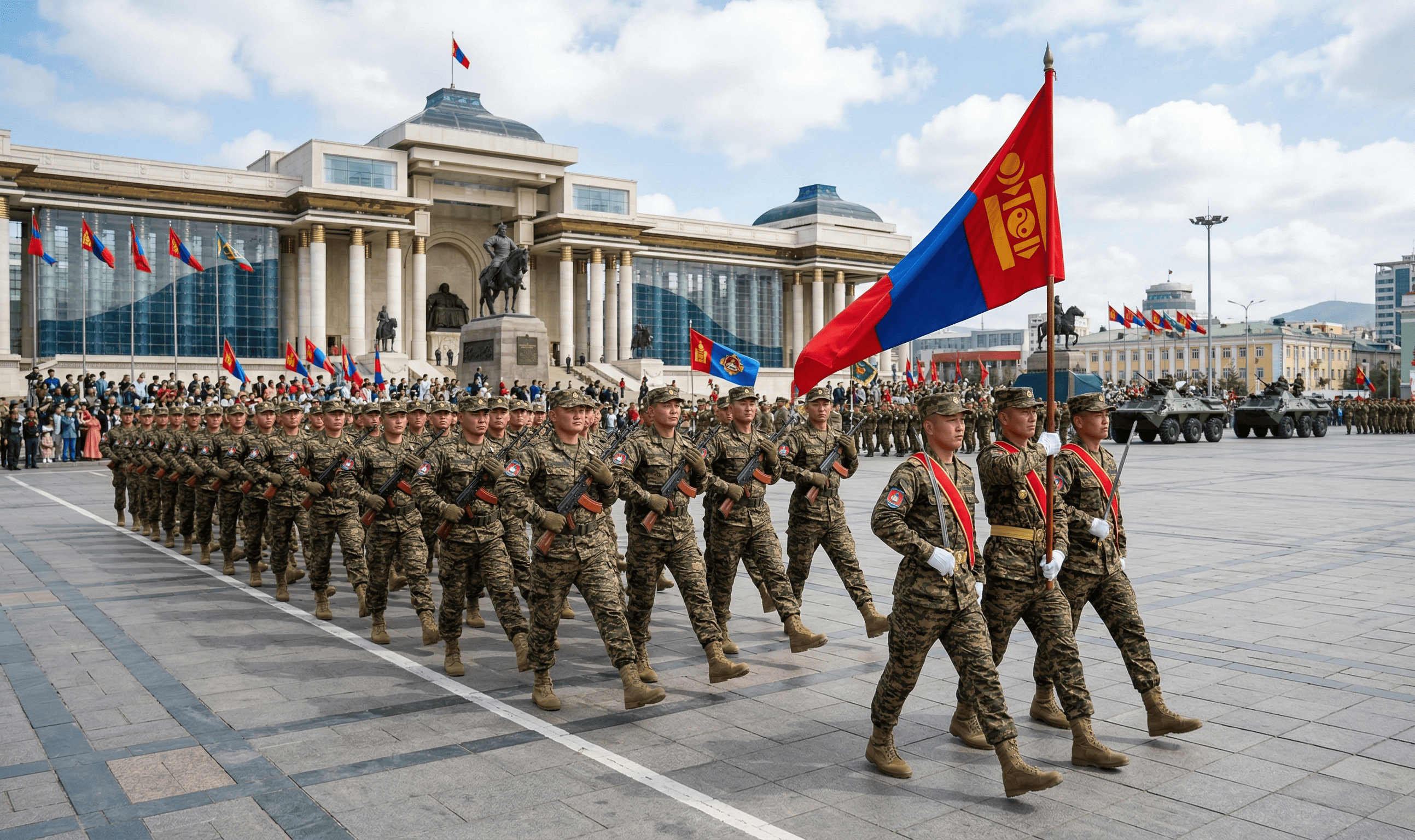
On March 18th, the day begins early in the barracks. Soldiers don their dress uniforms — the most formal of which draw directly from the attire of the imperial era, with traditional headwear, colours of the national flag, and decorations worn with pride.
In Ulaanbaatar, the official ceremonies are held on Sükhbaatar Square (also known as Genghis Khan Square), in the heart of the capital. The President of the Republic, the government and senior military commanders all take part. Medal presentations, official speeches and troop reviews mark the day.
In the regions, local garrisons organise their own commemorations. The atmosphere there is often more intimate, with strong participation from military families and local residents.
Decoration ceremonies
The day is an occasion to award medals and distinctions to soldiers who have distinguished themselves over the past year — in Mongolia or on overseas missions. Mongolia contributes to several UN peacekeeping operations around the world, and these soldiers are honoured prominently.
Equestrian demonstrations
The horse remains at the heart of Mongolian military identity. Military cavalry demonstrations are a highlight of the celebrations — a spectacle that directly echoes the legend of the armies of Genghis Khan, who once made Asia and Europe tremble beneath their hooves.
Military music and chants
Mongolian military bands blend Western instruments with traditional ones such as the morin khuur (horsehead fiddle). Military songs, often inspired by the Mongolian epic tradition, give the ceremonies an unexpectedly poetic dimension that stays with you long after the day is over.
Mongolia's modern army: a force for peace
Modern Mongolia has adopted a foreign policy known as the "third neighbour" doctrine — seeking to balance its relationships with its two powerful neighbours, Russia and China, by cultivating strong ties with Western democracies, the United States, Japan and the European Union.
Within this framework, the Mongolian armed forces play an important diplomatic role. Mongolia is one of the world's most active contributors to United Nations peacekeeping operations. Thousands of Mongolian soldiers have been deployed to Afghanistan, South Sudan, the Central African Republic, Sierra Leone, and other conflict zones.
There is a fascinating paradox here: the heirs of the greatest conquest army in history are today renowned for their commitment to building peace. This transformation is itself a source of national pride, celebrated every March 18th alongside the country's martial heritage.
"The heirs of the greatest conquest army in history are today among the world's most active contributors to United Nations peacekeeping missions."
Army Day vs Naadam: two festivals, one spirit
For travellers planning a trip to Mongolia, one question comes up often: should I visit for Army Day (March 18th) or for Naadam (July 11–13)?
Both celebrations share a common foundation — the honouring of Mongolian warrior virtues: physical strength, discipline, mastery of the horse. But they differ profoundly in form and atmosphere.
March 18 · Army Day
- → Official and solemn ceremonies
- → Military parades in dress uniform
- → Cavalry demonstrations
- → Few tourists, authentic atmosphere
- → Late winter, snow-dusted steppe landscapes
July 11–13 · Naadam
- → Wrestling, archery, horse racing
- → Grand popular celebration
- → Colourful traditional costumes
- → Peak tourist season
- → Summer, green steppe and infinite blue sky
If you dream of an unfiltered Mongolia, without tourist crowds, March 18th is a precious option. If you want the grand popular spectacle in the height of summer, Naadam remains unmissable. Ideally? Both.
Practical tips for attending the celebrations
Thinking of being in Mongolia on March 18th? Here are a few things to know before you go.
Dress for the cold
In mid-March, Ulaanbaatar temperatures still hover between −10°C and 0°C. Ceremonies take place outdoors. Thermal layers, a heavy coat and a warm hat are essential — but the spectacle is absolutely worth it.
Where to stand in Ulaanbaatar
Sükhbaatar Square (also called Genghis Khan Square) is the focal point of the official celebrations. Arrive early to secure a good spot. The area around the Government Palace also offers excellent views of the parades.
Photography at the ceremonies
Military ceremonies are generally open to the public. Be respectful and unobtrusive during the most solemn moments. Always ask before photographing soldiers up close — they will usually be delighted to pose, especially if you show genuine interest in their history.
A few words in Mongolian
Saying « Цэргийн баярын мэнд хүргэе » (tzérgiin bayariin ménd khürgué) — "Happy Army Day" — to a soldier or local will earn you smiles and warm welcome. Mongolians deeply appreciate visitors who make the effort to speak even a little of their language.
Travelling to Mongolia in March?
We know Mongolia in every season. Whether you want to be there for the March 18th celebrations, experience Naadam in July, or explore the steppe at your own pace — our team will design a journey that is uniquely yours.
"Every journey we create is unique. Tell us what you dream of experiencing."
Talk about my trip →